
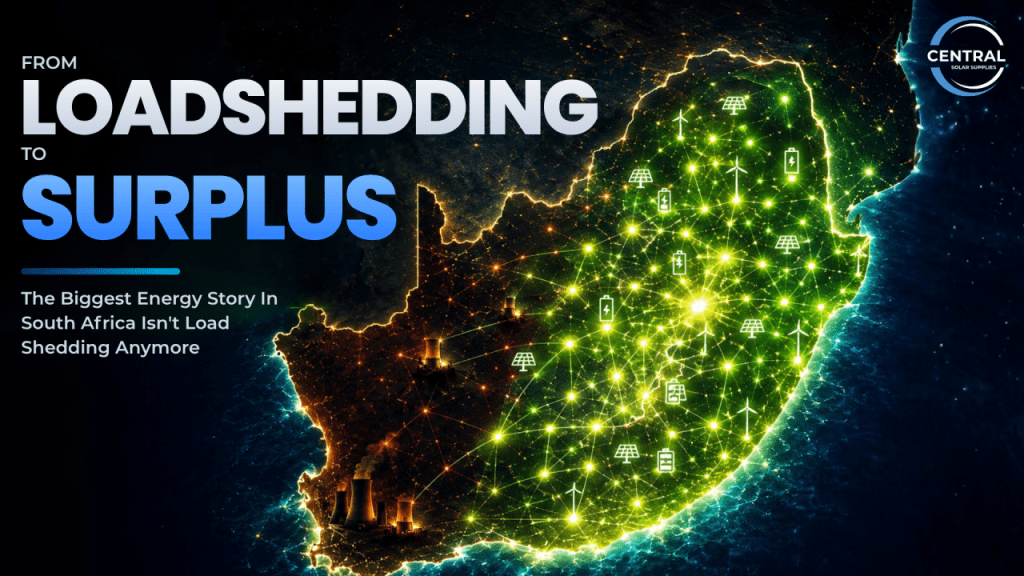
Not long ago, South Africa’s energy conversation was dominated by a single question:
“When is the next stage of load shedding?”
Today, the conversation is changing.
For the first time in years, Eskom is reporting periods of surplus generation capacity, while the country continues to experience significantly improved power system performance compared to the height of the electricity crisis. According to Eskom, improvements in generation performance have contributed to extended periods without load shedding and a more stable power system.¹
For a country that spent more than a decade battling electricity shortages, the idea of an energy surplus would have seemed almost impossible just a few years ago.
But perhaps the more important question is not whether South Africa currently has surplus capacity.
The real question is what happens next.
How Did We Get Here?
The improvement in South Africa’s electricity supply is the result of several factors working together.
Eskom’s generation recovery initiatives have improved the performance and availability of existing power stations.²
At the same time, businesses across the country have invested billions of rands into private generation capacity, including solar, battery storage, and embedded generation projects.³
The removal of restrictions on private power generation unlocked a wave of investment that fundamentally changed the country’s energy landscape. Companies that once relied entirely on Eskom increasingly began generating their own electricity.
As a result, pressure on the national grid decreased while available generation capacity improved.
The outcome has been a period of greater stability and fewer power interruptions.
A New Challenge: Creating Demand
According to recent reports, Eskom’s challenge is no longer solely producing enough electricity.
It is increasingly focused on stimulating demand for electricity as generation performance improves and excess capacity becomes available during certain periods.⁴
This represents a remarkable shift in the national conversation.
For years, South Africa’s energy problem was one of shortage.
Today, there are growing discussions about how to utilize available capacity to support economic growth, industrial expansion, and investment.
What Could This Mean For The Economy?
Reliable electricity is one of the most important foundations of economic growth.
When businesses have confidence in energy availability, they are more likely to invest in expansion, increase production capacity, hire employees, and commit capital to long-term projects.
The cost of load shedding extended far beyond electricity interruptions. It affected productivity, investor confidence, supply chains, and economic output across multiple sectors.
Improved energy stability has the potential to reverse many of these effects.
Manufacturing can increase production.
Mining operations can operate with greater certainty.
Commercial property developments become more attractive.
Investors gain confidence.
In many ways, reliable electricity acts as an economic multiplier.
Why The Story Is Not Over Yet
While recent progress is encouraging, most energy analysts agree that South Africa’s long-term energy security is not yet guaranteed.
The country’s generation fleet remains heavily dependent on ageing infrastructure, much of which will require significant maintenance, upgrades, or eventual replacement.⁵
At the same time, demand for electricity is expected to grow as economic activity increases.
Electric vehicles, data centers, electrification initiatives, industrial growth, and digital infrastructure will all place additional demands on the grid over the coming years.
This means that today’s surplus could become tomorrow’s shortage if investment in generation, storage, and transmission infrastructure does not continue.
The Rise Of A More Diverse Energy Future
Perhaps the most significant outcome of South Africa’s energy crisis is that it accelerated the transition toward a more diversified electricity system.
The future is unlikely to be defined by a single utility supplying all of the country’s energy needs.
Instead, South Africa is moving toward a more complex ecosystem that includes:
- Eskom generation
- Independent power producers
- Commercial solar projects
- Battery energy storage systems
- Embedded generation
- Energy wheeling and private power trading
This diversification may ultimately prove to be one of the most valuable outcomes of the crisis.
Conclusion
The emergence of surplus electricity capacity in parts of South Africa’s power system would have been difficult to imagine just a few years ago.
It is a sign of meaningful progress and a testament to the investments, reforms, and operational improvements that have taken place across the energy sector.
However, surplus capacity should not be viewed as the finish line.
It should be viewed as an opportunity.
An opportunity to stimulate economic growth.
An opportunity to attract investment.
An opportunity to modernize infrastructure.
And an opportunity to build an energy system that is more resilient, flexible, and sustainable than the one that existed before.
After years of asking whether South Africa had enough electricity, the country may soon find itself asking a very different question:
How do we make the most of it?
Sources:
- Eskom – Sustained generation performance continues to strengthen power system stability and long-term energy security.
- Eskom Summer Outlook 2025/26.
- Reuters – South Africa’s electricity reforms and private sector investment.
- Financial Times – “South Africa now has a power surplus, says Eskom chief.”
- OECD Economic Survey: South Africa – Reforming South Africa’s electricity sector.