
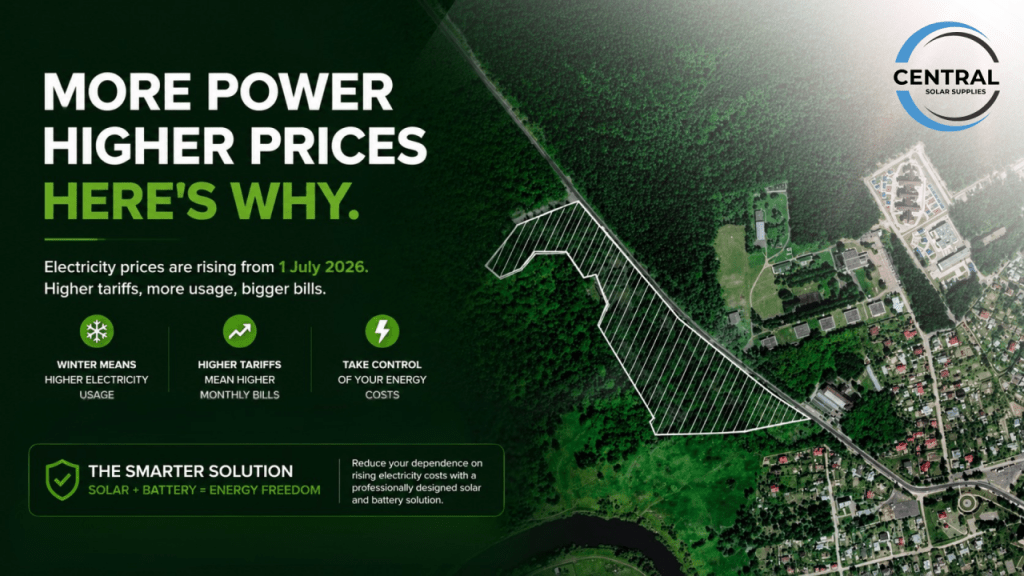
South Africa’s energy landscape is improving—but many businesses are still asking the same question: If we have more electricity, why are electricity prices still increasing?
For years, South Africa’s biggest energy challenge was simple: there wasn’t enough electricity.
Today, the situation looks very different.
Load shedding has reduced significantly, Eskom’s generation performance has improved, and private investment in solar and embedded generation has added thousands of megawatts of new capacity to the national energy mix.¹
Yet despite this encouraging progress, businesses and households continue to face rising electricity tariffs.
At first glance, it doesn’t make sense.
If supply is improving, shouldn’t prices come down?
The answer lies in understanding that electricity supply and electricity pricing are driven by very different factors.
More Electricity Doesn’t Mean Lower Costs
Imagine a factory that suddenly becomes more efficient.
It can produce more products than before, but it still has to repay loans, maintain equipment, pay salaries, and invest in future upgrades.
South Africa’s electricity system works in much the same way.
Improving generation performance reduces the risk of power shortages, but it doesn’t erase the financial obligations required to operate, maintain, and modernize the country’s electricity infrastructure.
The grid is becoming more reliable.
It isn’t becoming cheaper to run.
The Cost Of Maintaining The Grid
Electricity is far more than power stations.
Behind every light switch is an enormous network of transmission lines, substations, transformers, maintenance teams, system operators and distribution infrastructure. Much of South Africa’s electricity network requires ongoing maintenance, refurbishment and expansion after years of heavy use and underinvestment.²
At the same time, ageing infrastructure continues to require significant capital investment simply to maintain reliability.
Those costs exist whether demand is high or low.
Eskom’s Financial Reality
Over the past decade, Eskom has faced enormous financial pressure.
Debt servicing, operational costs, maintenance programs and investment in generation and transmission infrastructure all influence the cost of supplying electricity.
These factors form part of the tariff determination process overseen by the National Energy Regulator of South Africa (NERSA).³
In other words, electricity tariffs are not based solely on how much electricity is available.
They also reflect what it costs to keep the entire system operating sustainably.
Private Generation Has Changed The Landscape
South Africa has also experienced unprecedented investment in private energy.
Businesses, shopping centers, farms, warehouses and industrial facilities have installed thousands of megawatts of rooftop solar and embedded generation over the past few years.⁴
This has reduced pressure on the national grid and contributed to improved energy security.
Ironically, it has also changed the economics of electricity.
As more large consumers generate part of their own electricity, overall sales from the grid can decline. However, much of the cost of maintaining the electricity network remains fixed.
The infrastructure still has to be maintained regardless of how many kilowatt-hours are sold.
Reliability And Affordability Are Different Conversations
One of the biggest misconceptions is that solving load shedding would automatically lead to cheaper electricity.
These are two separate challenges.
The first is ensuring there is enough electricity available.
The second is determining how that electricity is financed, transmitted, distributed and maintained over the long term.
South Africa has made meaningful progress on the first challenge.
The second remains an ongoing economic and regulatory discussion.
What This Means For Business
For businesses, the conversation is evolving. A few years ago, energy planning focused primarily on reliability. Today, many organizations are asking a different question:
“How do we gain greater control over our long-term energy costs?”
Predictability has become just as valuable as availability. Businesses are increasingly looking beyond simply having access to electricity and focusing on creating greater certainty around one of their largest operating expenses.
Conclusion
South Africa’s improving electricity supply is a significant achievement. It creates opportunities for economic growth, investment and greater business confidence. However, a more reliable grid does not automatically translate into lower electricity prices. Electricity tariffs are influenced by infrastructure, maintenance, debt, regulation and the long-term cost of operating one of Africa’s largest power systems. The lights may be staying on more consistently. The next challenge is ensuring that electricity remains both reliable and affordable for the businesses that depend on it.
References
- Eskom, Generation Performance and System Updates – Improved plant performance and reduced load shedding.
- National Energy Regulator of South Africa (NERSA), Electricity Pricing Methodology – Explains the role of infrastructure costs, maintenance and long-term sustainability in electricity pricing.
- Eskom, 2026/27 Tariff Decision – NERSA-approved tariff adjustments and the factors influencing electricity pricing.
- Studies on South Africa’s electricity market and consumer behaviour show that rising tariffs have accelerated investment in private generation and renewable energy solutions.